
Section
Chart
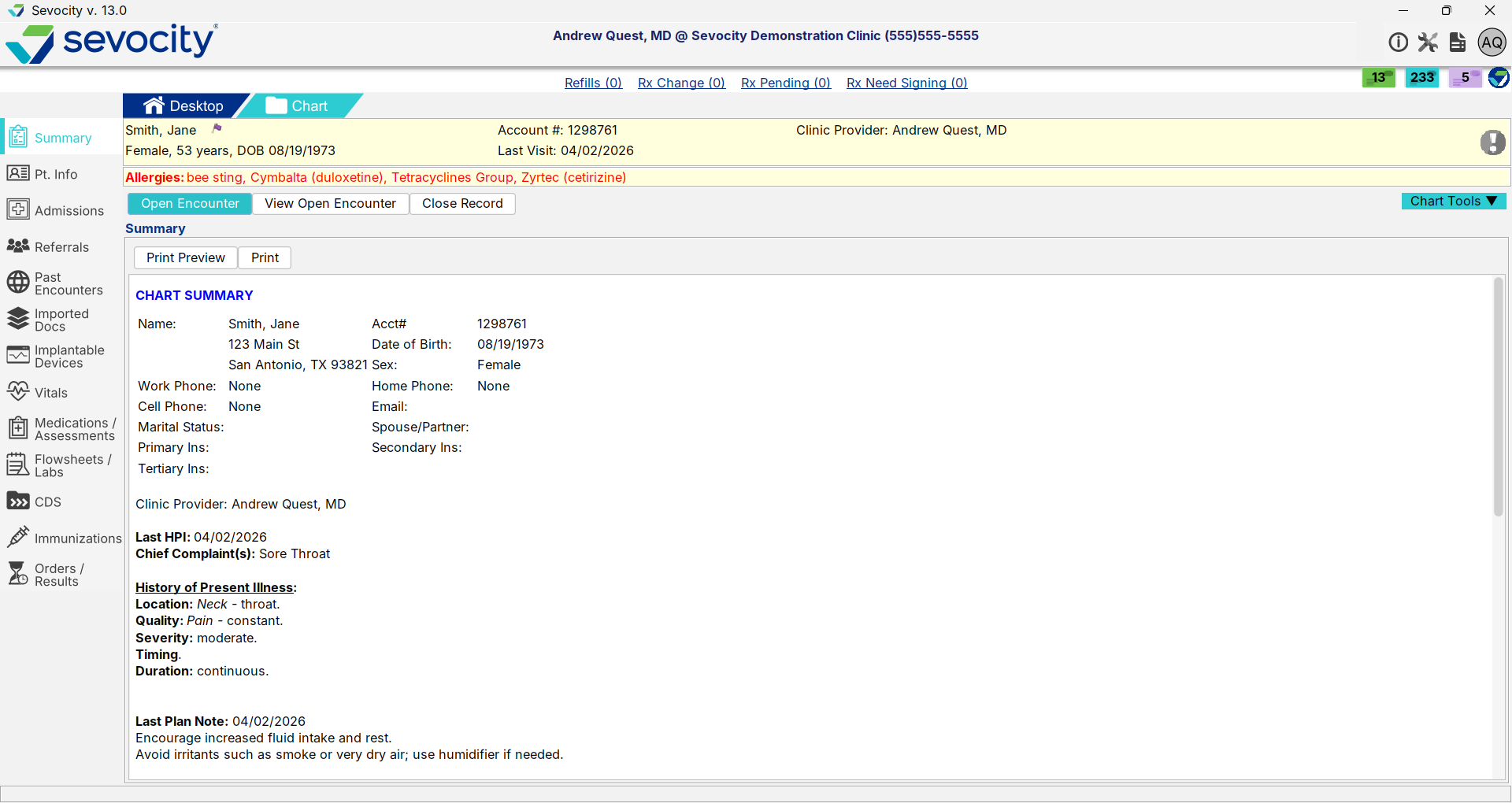
The Chart contains the patient’s demographic and clinical information. From the chart, a user can view a patient’s current and historical clinical information, start a new encounter, and perform a variety of patient-related tasks. Demographics and some clinical information, such as medications and vitals, can be added and updated from the chart.
Upon opening a chart, the chart Summary displays the patient’s demographic information and clinical information from the most recently finalized encounter.
Permissions
- Users with an Access Level of Summary and View-Only, Restricted Chart Entry, or Full Chart can view and add information in the chart. Users with an Access Level of Chart Folder can view the Summary tab and view and edit the Demographics tab only.
- Users must have an Access Level of Restricted Chart Entry or Full Chart to start a New Encounter. See Create a New Encounter from the Patient Chart
Configuration
Certain patient encounter information can be included or excluded from the chart Summary display at the user and CLINIC level by going to Tools > Preferences > CLINIC or [user] > Application Settings
The Clinic Administrator can customize Chart Alert Favorites in Clinic Settings: Alerts/Reminders/CDS
Chart Alerts
Chart Alerts are patient-specific alerts accessible from the patient header. These alerts can also be set to display on the patient header or upon opening a chart. The chart alert icon in the patient header indicates if the patient has an alert.
 (grey exclamation point): no patient alerts
 (red exclamation point): patient has one or more alerts
Chart Alerts is a communication tool. Alerts are not stored to the patient chart.
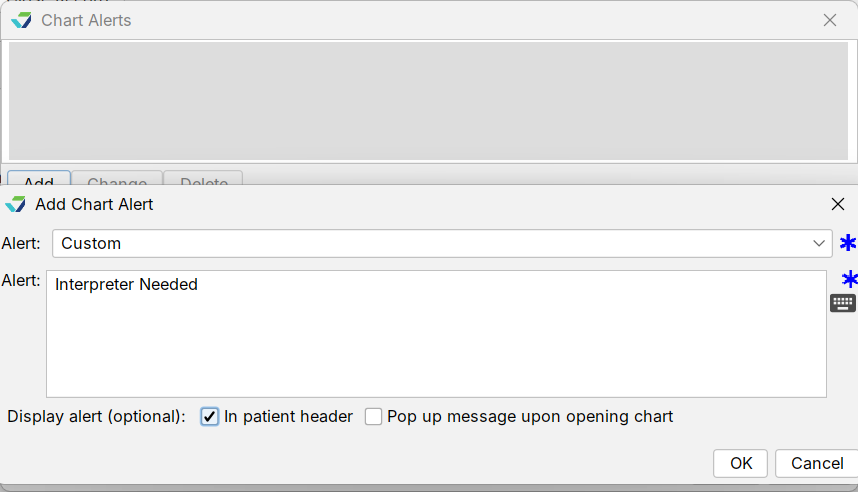
Add a Chart Alert
Click the chart alert icon in the patient header
Click Add
From the Alert list, select a chart alert favorite or select Custom
If creating a custom alert:
Populate the Alert field
Optional: select one or more Display alerts
Click OK
Note: custom alerts are not saved to the favorites list for future use
- Click Save
Update a Chart Alert
Click the chart alert icon in the patient header
Select an alert and click Change
Update the Alert text and Display alert options, as needed
Click OK
Click Save
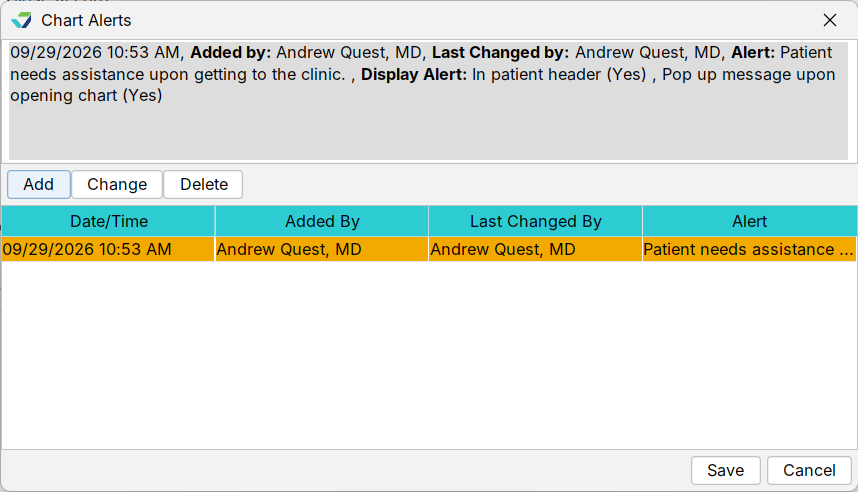
View a Chart Alert
Clicking the chart alert icon displays all patient alerts. To view the alert detail, select the alert from the list.
Delete a Chart Alert
Click the chart alert icon in the patient header
Select an alert and click Delete
A message will display to verify the user would like to delete the alert. Click Yes
Click Save
Warning
Once deleted, an alert cannot be retrieved or restored
The following tabs are available in the patient chart:
Chart Tools menu: contains tools to complete a variety of patient-related tasks
Demographics: used to document and maintain patient demographics, insurance, and contacts
Admissions: used to document a patient’s admission and discharge events
Referrals: used to create and manage patient referrals
Past Encounters: contains all the patient’s finalized encounters
Imported Documents: used to add documents or images to the patient chart
Implantable Devices: used to document and maintain a patient’s implantable devices
Vitals/Growth Charts: used to view and document patient vital signs and generate growth charts for pediatric patients
Medications and Assessments: displays a patient’s active and historical medications and assessments and is used to modify a patient’s medications, allergies, and pharmacy information
Flowsheets and Labs: used to view and add custom flowsheets and view labs saved to the patient chart
CDS: displays a patient’s inclusion in a Clinical Decision Support and the status of the guideline
Immunizations: displays immunizations documented for a patient
Pending Orders and Results Review: displays a list of orders that have not been completed for a patient and patient e-Labs results that need to be reviewed
Articles
-
Consents
The Consents tab records and displays patient preferences for contact methods, data exchange, and ambient listening AI (Add-On Feature) consent status. Options for data exchange consent status are dependent on a clinic’s interface setup.
-
Referrals
The Referrals tab is used to create and manage patient referrals. Referrals can also be created within a patient encounter from the Orders/Referrals tab.
-
Past Encounters
The Past Encounters tab contains all the patient’s finalized encounters. Patient encounters can be amended and cosigned from this tab, and users can view and generate documents from finalized patient encounters, such as billing summaries and plan notes.
-
Implantable Devices
The Implantable Devices tab is used to document and maintain a patient’s implantable devices, such as pacemakers and IUDs.
-
Chart Tools
The Chart Tools menu contains tools to complete patient-related tasks and is available from every tab in the patient chart. The following items are available in the Chart Tools menu: C‑CDA Reconciliation: imports and reconciles locally stored C‑CDA files into a patient chart Confidential Blank Note: creates a Blank Note Encounter with restricted view access […]
-
Vitals/Growth Charts
The Vitals/Growth Charts tab is used to view and document patient vital signs and generate growth charts for pediatric patients. For patients 18 years of age and older, the tab displays as Vitals.
-
Pending Orders and Results Review
The Pending Orders/Results Review tab displays orders that have not been completed for a patient and patient e-Labs results that need to be reviewed.
-
Send Clinical Summary
The Send Clinical Summary tool uses Direct Message to securely and electronically transmit a patient’s clinical information as a Continuity of Care Document (CCD) in a C‑CDA format, which can be viewed and incorporated into the patient’s record by the receiving provider.
-
Medications and Assessments
The Medications/Assessments tab displays a patient’s active and historical medications and assessments. Patient medications, allergies, and pharmacy information can also be modified from this tab.
-
Insurance
The Insurance tab records and displays responsible party and insurance plan information for a patient. A patient can have up to three insurance plans in their chart.
-
Letters
The Letter tool is used to create and store patient letters.
-
C‑CDA Reconciliation Tool
The C‑CDA Reconciliation tool imports and reconciles locally stored C‑CDA files into a patient’s chart. The C‑CDA Reconciliation tool is also accessible from the Tools Menu.
-
Admissions
The Admissions tab is used to document a patient’s admission and discharge events for residential care or skilled nursing facilities.
-
Send Portal Message
The Send Portal Message tool creates and sends messages to patients through the Patient Portal.
-
CDS (Clinical Decision Support)
The CDS tab displays a patient’s inclusion in a Clinical Decision Support and the status of the CDS. From this tab, a user can add a custom CDS, change, or override a patient’s current CDS.
-
Chart Access
The Chart Access tab enables a user to restrict access to a patient chart. Chart access can be restricted by user or by Access Level. By default, users with chart access can view all charts unless the chart has been restricted.
-
Patient Information
The Patient Info tab records and displays patient demographic information in five tabs: Patient, Additional Info, Related Person, Pregnancy, and Notes. The Pregnancy tab displays for patients with a Birth Sex of female.
-
Contacts
The Contacts tab records and displays Emergency and Alternate contacts for a patient.
-
Flowsheets and Labs
The Flowsheets/Labs chart tab is used to view and add Custom and Standard flowsheets and view labs saved to the patient chart.
-
Confidential Blank Note
A Confidential Blank Note encounter is a free text documentation tool for adding notes or information of a sensitive nature to a patient’s chart.