
| Measure: Percentage of patients aged 12 years and older screened for depression on the date of the encounter or up to 14 days prior to the date of the encounter using an age-appropriate standardized depression screening tool AND if positive, a follow-up plan is documented on the date of or up to two days after the date of the qualifying encounter | ||
| Measure Type | High Priority Measure | Scoring |
| Process | No | A higher percentage indicates better quality |
| Denominator | All patients aged 12 years and older at the beginning of the measurement period with at least one qualifying encounter during the measurement period |
| Numerator | Patients screened for depression on the date of the encounter or up to 14 days prior to the date of the encounter using an age-appropriate standardized tool AND if positive, a follow-up plan is documented on the date of or up to two days after the date of the qualifying encounter |
| Denominator Exceptions |
|
| Denominator Exclusions | Patients who have ever been diagnosed with bipolar disorder at any time prior to the qualifying encounter |
Denominator
Patients who meet the following criteria will be included in the denominator:
Age is ≥ 12 years at the beginning of the Measurement Period
AND
- Have at least one eligible encounter during the Measurement Period finalized by the EC
Encounter Codes Eligible for Denominator
CPT: 59400, 59510, 59610, 59618, 90791, 90792, 90832, 90834, 90837, 92625, 96105, 96110, 96112, 96116, 96125, 96136, 96138, 96156, 96158, 97165, 97166, 97167, 97802, 97803, 99078, 99202, 99203, 99204, 99205, 99212, 99213, 99214, 99215, 99304, 99305, 99306, 99307, 99308, 99309, 99310, 99315, 99316, 99341, 99342, 99344, 99345, 99347, 99348, 99349, 99350, 99384, 99385, 99386, 99387, 99394, 99395, 99396, 99397, 99401, 99402, 99403, 99404, 99424, 99483, 99484, 99491, 99492, 99493, 97161, 97162, 97163, 97164, 99441, 99442, 99443, 98966, 98967, 98968
HCPCS: G0101, G0402, G0438, G0439, G0444, G0270, G0271
Denominator Exceptions
A patient will be counted as an exception for this measure if there is a medical reason they did not receive a depression screening or if the patient refused.
Document an Exception from the Adult/Adolescent Depression Screening Flowsheet
- Go to Encounter > Flowsheets/Labs > Standard or Chart > Flowsheets/Labs > Standard
- Click Add New Flowsheet
- Select the appropriate Depression Screening flowsheet and click Add
- Adolescent Depression Screening is for patients aged ≥ 12 years and < 17 years
- Adult Depression Screening is for patients aged ≥ 18 years
- Patients whose age is 17 at the start of the Measurement Period may be screened using either the Adolescent or Adult depression screening flowsheet
- Click Add Column
- Select a Value from the Depression Screening Not Done Due to list
- Click OK to save
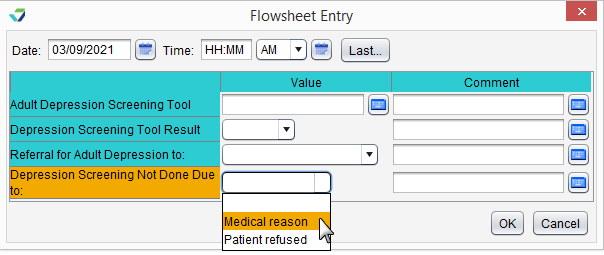
Document an Exception from the PHQ-2, PHQ-9, or Zung SDS Flowsheet
- Go to Encounter > Flowsheets/Labs > Standard or Chart > Flowsheets/Labs > Standard
- Click Add New Flowsheet
- Select the PHQ-2 or PHQ-9 or Zung Self-Rating Depression Scale flowsheet and click Add
- Click Add Column
- Select the checkbox for Patient Declined Screening
- Click OK to save
Denominator Exclusions
Patients with an active or resolved (historical) diagnosis of bipolar disorder will be excluded from the measure. The diagnosis must be documented prior to the eligible encounter date.
Diagnoses are documented in the Assessment tab of an encounter. A comprehensive list of eligible diagnosis codes for bipolar disorder can be located here.
Numerator
A patient will be counted in the numerator if they received a depression screening on the same day as their eligible encounter or in the 14 days prior to the encounter.
- If the result of the screening is Positive, a follow-up plan must be documented on the day of or up to two days after the date the eligible encounter for the patient to be counted in the numerator.
Depression Screening
A depression screening can be documented from the following standard flowsheets: Adult Depression Screening, Adolescent Depression Screening, PHQ-2, PHQ-9, or Zung Self-Rating Depression Scale.
Document a Screening from the PHQ-2, PHQ-9, or Zung SDS Flowsheet
- Go to Encounter > Flowsheets/Labs > Standard or Chart > Flowsheets/Labs > Standard
- Click Add New Flowsheet
- Select the PHQ-2 or PHQ-9 or Zung Self-Rating Depression Scale flowsheet and click Add
- Click Add Column
- Select a Value for all questions in the PHQ or Zung SDS
- Click OK to save
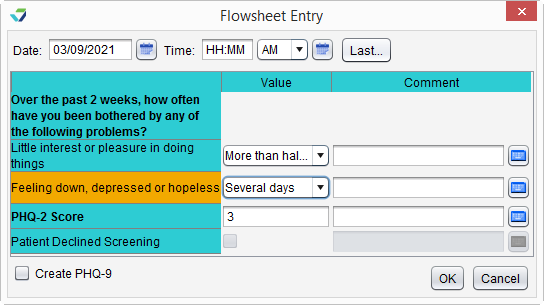
Document a Screening from the Adult/Adolescent Depression Screening Flowsheet
- Go to Encounter > Flowsheets/Labs > Standard or Chart > Flowsheets/Labs > Standard
- Click Add New Flowsheet
- Select the appropriate Depression Screening flowsheet and click Add
- Adolescent Depression Screening is for patients aged ≥ 12 years and < 17 years
- Adult Depression Screening is for patients aged ≥ 18 years
- Patients whose age is 17 at the start of the Measurement Period may be screened using either the Adolescent or Adult depression screening flowsheet
- Click Add Column
- Type the name of the Adult/Adolescent Screening Tool used in theValue field
- Select a Depression Screening Tool Result
- Click OK to save

Follow-Up Plan for a Positive Finding
If the result of the depression screening is Positive, at least one of the following actions must be performed and documented:
- Referral to a practitioner who is qualified to diagnose and treat depression
- Prescription for anti-depression medication
A PHQ-2 score ≥ 3 will require a follow-up plan; a PHQ-9 score ≥ 5 will require a follow-up plan; a Zung SDS score > 49 will require a follow-up plan
Document Referral Provided
From the Adult/Adolescent Depression Screening flowsheet, select a Value from the Referral for Adult/Adolescent Depression to list.

Note
This action does not create a referral in Sevocity. Referrals are created from the Referrals tab in the chart or from the Orders/Referrals tab in an encounter
Medication
To prescribe a medication, go to Encounter > Medications > Manage/Prescribe Meds > New Prescription or Chart > Medications/Assessments > Modify.A comprehensive list of eligible anti-depression medications can be located here.
eCQI Reference
Return to 2024 eCQMs