
| Measure: Percentage of patients 18-85 years of age who had a diagnosis of essential hypertension starting before and continuing into, or starting during the first six months of the measurement period, and whose most recent blood pressure was adequately controlled (<140/90mmHg) during the measurement period | ||
| Measure Type | High Priority Measure | Scoring |
| Outcome | Yes | A higher percentage indicates better quality |
| Denominator | Patients 18-85 years of age by the end of the measurement period who had a visit and diagnosis of essential hypertension starting before and continuing into, or starting during the first six months of the measurement period |
| Numerator | Patients whose most recent blood pressure is adequately controlled (systolic blood pressure < 140 mmHg and diastolic blood pressure < 90 mmHg) during the measurement period |
| Denominator Exceptions | None |
| Denominator Exclusions |
|
Denominator
Patients who meet the following criteria will be included in the denominator:
Age is 18 years to 85 years at the end of the Measurement Period
AND
Have an active diagnosis of essential hypertension at the start of the Measurement Period or were diagnosed with essential hypertension within the first six months of the Measurement Period
AND
- Must have at least one eligible encounter during the Measurement Period finalized by the EC
Encounter Codes Eligible for Denominator
CPT: 99202, 99203, 99204, 99205, 99212, 99213, 99214, 99215, 99395, 99396, 99397, 99385, 99386, 99387, 99341, 99342, 99344, 99345, 99347, 99348, 99349, 99350, 98970, 98971, 98972, 98980, 98981, 99421, 99422, 99423, 99457, 99458, 98008, 98009, 98010, 98011, 98012, 98013, 98014, 98015, 98966, 98967, 98968, 99441, 99442, 99443
HCPCS: G0402, G0438, G0439, G0071, G2010, G2012, G2250, G2251, G2252
Diagnosis
The patient must have an active diagnosis of essential hypertension at the start of the Measurement Period or be diagnosed with essential hypertension within the first six months of the Measurement Period. Diagnoses are documented in the Assessment tab of an encounter.
The eligible diagnosis codes for essential hypertension are:
ICD-10: I10
Denominator Exclusions
A patient will be excluded from this measure if they meet any of the following conditions:
- Has an active diagnosis of pregnancy, end stage renal disease, kidney transplant recipient, or chronic kidney disease, stage 5 during the Measurement Period
- Received services related to kidney disease or a kidney transplant before or during the Measurement Period
- Is in hospice care for any part of the Measurement Period
- Is receiving palliative care for any part of the Measurement Period
- Age is ≥ 66 at the end of the Measurement Period and are living long term in a nursing home any time on or before the end of the Measurement Period
- Age is 66-80 at the end of the Measurement Period and has evidence of frailty and advanced illness
- Age is ≥ 81 at the end of the measurement period with an indication of frailty for any part of the measurement period
Diagnosis
Diagnoses are documented in the Assessment tab of an encounter. A comprehensive list of eligible diagnosis codes for this exclusion can be located here.
Procedure Codes Eligible for Denominator Exclusion
To document the performance of a services received related to kidney disease or a kidney transplant, go to Encounter > Orders/Procedure > Orders/Referrals and click Add to add one of the eligible codes listed below. Order Status must be marked as Complete in order to count as an exclusion.
Dialysis Services
CPT: 90935, 90937, 90945, 90947, 90997, 90999, 99512
HCPCS: G0257, S9339
Kidney Transplant
CPT: 50360, 50365, 50380
HCPCS: S2065
ESRD Monthly Outpatient Services
CPT: 90951, 90952, 90953, 90954, 90955, 90956, 90957, 90958, 90959, 90960, 90961, 90962, 90963, 90964, 90965, 90966, 90967, 90968, 90969, 90970, 90989, 90993, 90997, 90999, 99512
Hospice Care Services
To document hospice care ambulatory services, go to Encounter > Orders/Procedure > Orders/Referrals and click Add to add one of the eligible codes listed below:
CPT: 99377, 99378
HCPCS: G0182
Order Status must be marked as Pending or Complete.
To document hospice care encounter services, go to Encounter > Orders/Procedure > Orders/Referrals and click Add to add one of the eligible codes listed below:
HCPCS: G9473, G9474, G9475, G9476, G9477, G9478, G9479, Q5003, Q5004, Q5005, Q5006, Q5007, Q5008, Q5010, S9126, T2042, T2043, T2044, T2045, T2046
Order Status must be marked as Complete.
Palliative Care
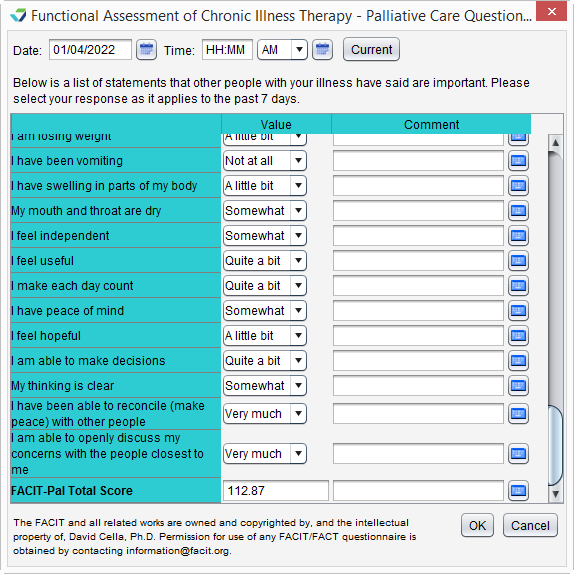
Palliative care services can be documented using the FACIT-Pal Questionnaire flowsheet, as an order, or as a diagnosis.
FACIT-Pal Questionnaire Flowsheet
Go to Encounter > Flowsheets/Labs > Standard or Chart > Flowsheets/Labs > Standard
Click Add New Flowsheet
Select the FACIT-Pal Questionnaire flowsheet and click Add
Click Add Column
Populate the patient’s responses to the questions as appropriate
Click OK to save
Palliative Care Services Order
Go to Encounter > Orders/Procedure > Orders/Referrals and click Add to add one of the eligible codes listed below:
HCPCS: G9054
Order Status must be marked as Complete.
Palliative Care Diagnosis
Diagnoses are documented in the Assessment tab of an encounter. The eligible diagnosis code for palliative care is:
ICD-10: Z51.5
Living Long Term in a Nursing Home
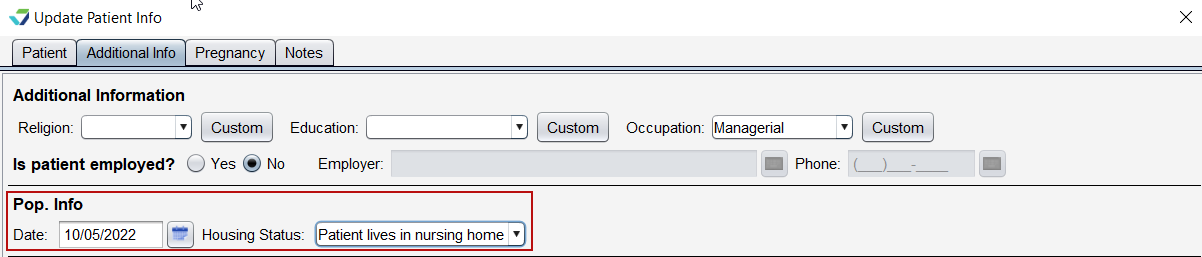
To document a nursing home stay:
Go to Chart > Demographics > Patient Info
Click Update
Click Additional Info tab
Populate the Date field in the Pop. Info section
Select Patient lives in nursing home for Housing Status
Click Save
Frailty and Advanced Illness
Frailty
A patient has evidence of frailty if they meet any of the following criteria:
- Has an active diagnosis of Frailty during the Measurement Period
- Has an active diagnosis of Frailty Symptom during the Measurement Period
- Is using a frailty device during the Measurement Period
- Has a frailty encounter during the Measurement Period
Frailty Diagnosis
“Frailty” refers to a range of conditions that includes falls and problems affecting mobility.
Diagnoses are documented in the Assessment tab of an encounter. A comprehensive list of eligible diagnosis codes for frailty can be located here.
Frailty Symptom Diagnosis
Diagnoses are documented in the Assessment tab of an encounter. The eligible diagnosis codes for frailty symptoms are:
ICD-10: R26.2, R26.89, R26.9, R53.1, R53.81, R54, R62.7, R63.4, R63.6, R64
Frailty Device Use
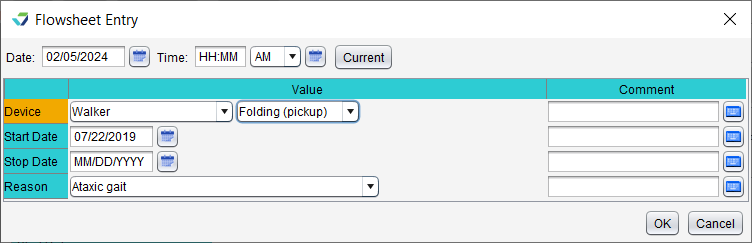
To document the patient’s use of a frailty device:
- Go to Encounter > Flowsheets/Labs > Standard or Chart > Flowsheets/Labs > Standard
- Click Add New Flowsheet
- Select the Frailty Device flowsheet and click Add
- Click Add Column
- Select a Device and the type (Value) of device
- Populate a usage Start Date for the device
- Optional: populate a usage Stop Date for the device
- The Stop Date cannot occur prior to the start of the Measurement Period
- Optional: populate a Reason for use of the device
- Click OK to save
Frailty Encounter Codes Eligible for Denominator Exclusion
CPT: 99504, 99509
HCPCS: G0162, G0299, G0300, G0493, G0494, S0271, S0311, S9123, S9124, T1000, T1001, T1002, T1003, T1004, T1005, T1019, T1020, T1021, T1022, T1030, T1031
Advanced Illness
A patient has evidence of advanced illness if they meet any of the following criteria:
- Had an active diagnosis of Advanced Illness during the Measurement Period or in the year prior
- Was prescribed medication for dementia during the Measurement Period or in the year prior
Advanced Illness Diagnosis
“Advanced illness” refers to a wide range of conditions and includes diseases such as Alzheimer’s disease, cancer, and heart failure.
Diagnoses are documented in the Assessment tab of an encounter. A comprehensive list of eligible diagnosis codes for advanced illness can be located here.
Medication
To prescribe a medication, go to Encounter > Medications > Manage/Prescribe Meds > New Prescription or Chart > Medications/Assessments > Modify. A comprehensive list of eligible dementia medications can be located here.
Numerator
A patient will be counted in the numerator if they have a documented blood pressure reading of < 140/90 during their most recent encounter during the Measurement Period.
- Blood pressure readings taken during an emergency department visit will not count toward the numerator
- If no blood pressure is recorded during the Measurement Period, the patient’s blood pressure is assumed not controlled
- If there are multiple blood pressure readings on the same day, the lowest systolic and the lowest diastolic reading will be counted toward the numerator
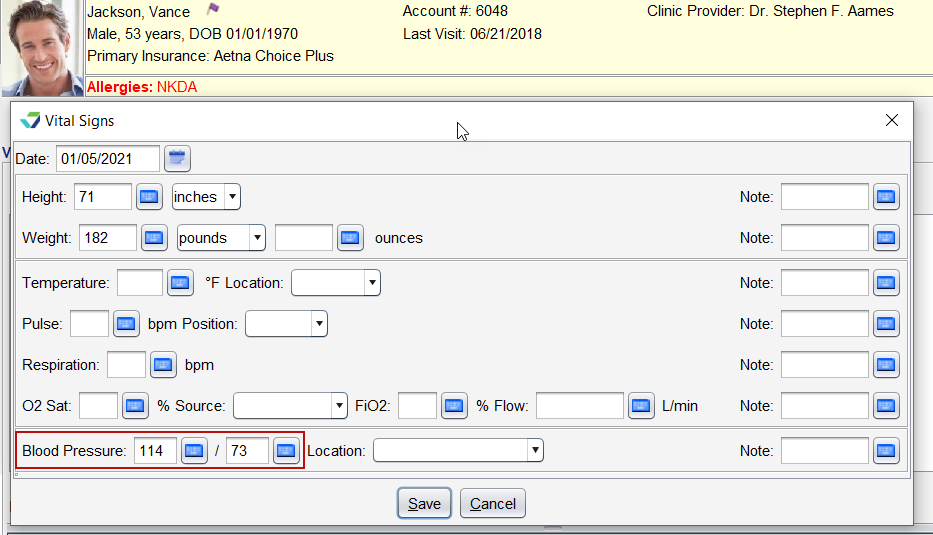
Documenting Blood Pressure
Blood pressure is documented in the Vitals tab of an encounter.
To document blood pressure, go to Encounter > Vitals > click Add/Column
eCQI Reference
Return to 2026 eCQMs