
Measure: Percentage of patients 65 years of age and older who were ordered at least two high-risk medications from the same drug class. Three rates are reported:
| ||
| Measure Type | High Priority Measure | Scoring |
| Process | Yes | A lower percentage indicates better quality |
| Denominator | Patients 65 years and older at the end of the measurement period who had a visit during the measurement period |
| Numerator | Rate 1 : Patients with at least two orders of high-risk medications from the same drug class on different days
Rate 2: Patients with at least two orders of high-risk medications from the same drug class (i.e., antipsychotics and benzodiazepines) on different days except for appropriate diagnoses
Total rate (the sum of the two previous numerators, deduplicated) |
| Denominator Exceptions | None |
| Denominator Exclusions |
|
Denominator
Patients who meet the following criteria will be included in the denominator:
Age is ⥠65 years at the end of the Measurement Period
AND
- Have at least one eligible encounter during the Measurement Period finalized by the EC
Encounter Codes Eligible for Denominator
CPT: 99202, 99203, 99204, 99205, 99212, 99213, 99214, 99215, 92002, 92004, 92012, 92014, 99395, 99396, 99397, 99304, 99305, 99306, 99307, 99308, 99309, 99310, 99315, 99316, 99385, 99386, 99387, 99341, 99342, 99344, 99345, 99347, 99348, 99349, 99350, 98008, 98009, 98010, 98011, 98012, 98013, 98014, 98015, 98966, 98967, 98968, 99441, 99442, 99443, 98970, 98971, 98972, 98980, 98981, 99421, 99422, 99423, 99457, 99458, 99211
HCPCS: G0402, G0438, G0439, G0071, G2010, G2012, G2250, G2251, G2252
Denominator Exclusions
A patient will be excluded from this measure if they meet any of the following conditions:
- Is in hospice care for any part of the Measurement Period
- Is receiving palliative care for any part of the Measurement Period
Hospice Care Services
To document hospice care ambulatory services, go to Encounter > Orders/Procedure > Orders/Referrals and click Add to add one of the eligible codes listed below:
CPT: 99377, 99378
HCPCS: G0182
Order Status must be marked as Pending or Complete.
To document hospice care encounter services, go to Encounter > Orders/Procedure > Orders/Referrals and click Add to add one of the eligible codes listed below:
HCPCS: G9473, G9474, G9475, G9476, G9477, G9478, G9479, Q5003, Q5004, Q5005, Q5006, Q5007, Q5008, Q5010, S9126, T2042, T2043, T2044, T2045, T2046
Order Status must be marked as Complete.
Palliative Care
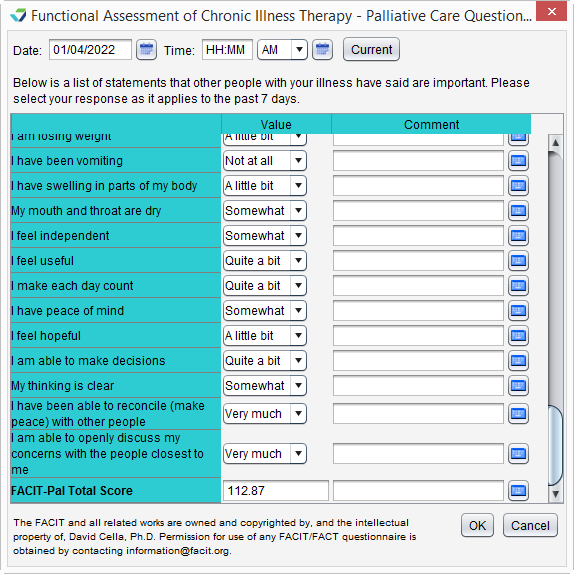
Palliative care services can be documented using the FACIT-Pal Questionnaire flowsheet, as an order, or as a diagnosis.
FACIT-Pal Questionnaire Flowsheet
Go to Encounter > Flowsheets/Labs > Standard or Chart > Flowsheets/Labs > Standard
Click Add New Flowsheet
Select the FACIT-Pal Questionnaire flowsheet and click Add
Click Add Column
Populate the patient’s responses to the questions as appropriate
Click OK to save
Palliative Care Services Order
Go to Encounter > Orders/Procedure > Orders/Referrals and click Add to add one of the eligible codes listed below:
HCPCS: G9054
Order Status must be marked as Complete.
Palliative Care Diagnosis
Diagnoses are documented in the Assessment tab of an encounter. The eligible diagnosis code for palliative care is:
ICD-10: Z51.5
Numerator
Rate 1: A patient will be counted in the numerator if the patient has at least two orders of high-risk medications from the same drug class on different days.
At least two orders of high-risk medication from the same drug class
OR
At least two orders of high-risk medication from the same drug class with summed days supply greater than 90 days
OR
At least two orders of high-risk medications from the same drug class each exceeding average daily dose criteria
A high-risk medication is identified as: a prescription for medications classified as high-risk at any dose and for any duration; or as prescriptions for medications classified as high-risk at any dose with greater than a 90-day supply.
A comprehensive list of eligible high-risk medications can be located here.
Rate 2: A patient will be counted in the numerator if the patient has:
Two or more orders for antipsychotics on different days, and who did not have a diagnosis of schizophrenia, schizoaffective disorder, or bipolar disorder on or between January 1 of the year prior to the measurement period and the IPSD for antipsychotics.
Two or more orders for benzodiazepines on different days, and who did not have a diagnosis of seizure disorders, rapid eye movement sleep behavior disorder, benzodiazepine withdrawal, ethanol withdrawal, or severe generalized anxiety disorder on or between January 1 of the year prior to the measurement period and the IPSD for benzodiazepines
A comprehensive list of eligible antipsychotics and benzodiazepines can be located here.
The Total Rate is the sum of Rate 1 and Rate 2, deduplicated.
Numerator Exclusions
For Rate 2:
A patient with two or more antipsychotic prescriptions ordered will be excluded if they have a diagnosis of schizophrenia, schizoaffective disorder, or bipolar disorder on or between January 1 of the year prior to the Measurement Period and the first prescription start date for antipsychotics.
A patient with two or more benzodiazepine prescriptions ordered will be excluded if they have a diagnosis of seizure disorders, rapid eye movement sleep behavior disorder, benzodiazepine withdrawal, ethanol withdrawal, or severe generalized anxiety disorder on or between January 1 of the year prior to the Measurement Period and the first prescription start date for benzodiazepines.
Diagnoses are documented in the Assessment tab of an encounter. A comprehensive list of eligible diagnosis codes for the conditions that meet the Numerator Exclusions can be located here.
eCQI Reference
Return to 2026 eCQMs