
| Measure: Percentage of patients, regardless of age, with a diagnosis of dementia for whom an assessment of cognition is performed and the results reviewed at least once within a 12-month period | ||
| Measure Type | High Priority Measure | Scoring |
| Process | Yes | A higher percentage indicates better quality |
| Denominator | All patients, regardless of age, with a diagnosis of dementia |
| Numerator | Patients for whom an assessment of cognition is performed and the results reviewed at least once within a 12-month period |
| Denominator Exceptions | Documentation of patient reason(s) for not assessing cognition |
| Denominator Exclusions | None |
Denominator
Patients who meet the following criteria will be included in the denominator:
Have an eligible encounter with an active diagnosis of dementia during the Measurement Period finalized by the EC
AND
- Have at least one eligible qualifying encounter during the Measurement Period finalized by the EC
Dementia Encounter
Encounter Codes Eligible for Denominator
CPT: 90791, 90792, 90832, 90834, 90837, 96116, 97165, 97166, 97167, 97168, 99201, 99202, 99203, 99204, 99205, 99212, 99213, 99214, 99215, 99241, 99242, 99243, 99244, 99245, 99304, 99305, 99306, 99307, 99308, 99309, 99310, 99315, 99316, 99318, 99324, 99325, 99326, 99327, 99328, 99334, 99335, 99336, 99337, 99341, 99342, 99343, 99344, 99345, 99347, 99348, 99349, 99350
Diagnosis
Diagnoses are documented in the Assessment tab of an encounter. The eligible diagnosis codes for dementia are:
ICD-10: A52.17, F01.50, F01.51, F02.80, F02.81, F03.90, F03.91, F05, F06.8, G30.0, G30.1, G30.8, G30.9, G31.01, G31.09, G31.83
Qualifying Encounter
Encounter Codes Eligible for Denominator
CPT: 90791, 90792, 90832, 90834, 90837, 96116, 97165, 97166, 97167, 97168, 99201, 99202, 99203, 99204, 99205, 99212, 99213, 99214, 99215, 99241, 99242, 99243, 99244, 99245, 99304, 99305, 99306, 99307, 99308, 99309, 99310, 99315, 99316, 99318, 99324, 99325, 99326, 99327, 99328, 99334, 99335, 99336, 99337, 99341, 99342, 99343, 99344, 99345, 99347, 99348, 99349, 99350, 99441, 99442, 99443, 99421, 99422, 99423, 99024, 99251, 99252, 99253, 99254, 99255
Denominator Exceptions
A patient will be counted as an exception for this measure if there is a documented patient reason for not performing a cognitive assessment.
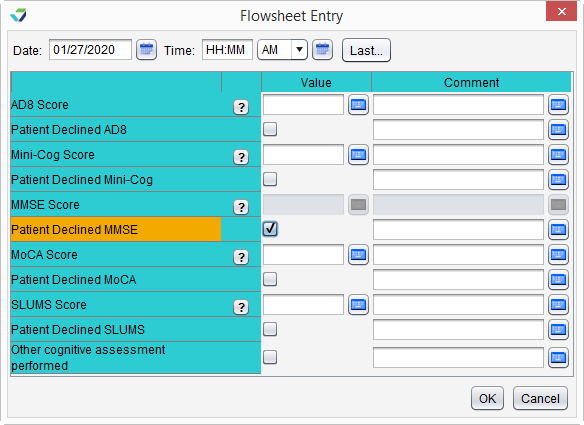
Document an Exception from the Cognitive Assessment Flowsheet
- Go to Encounter > Flowsheets/Labs > Standard or Chart > Flowsheets/Labs > Standard
- Click Add New Flowsheet
- Select the Cognitive Assessment flowsheet and click Add
- Click Add Column
- Select the ‘Patient declined…’ checkbox for the AD8, Mini-Cog, MMSE, MoCA, or SLUMS assessment
- Click OK to save
Document an Exception from the Orders/Procedure Tab
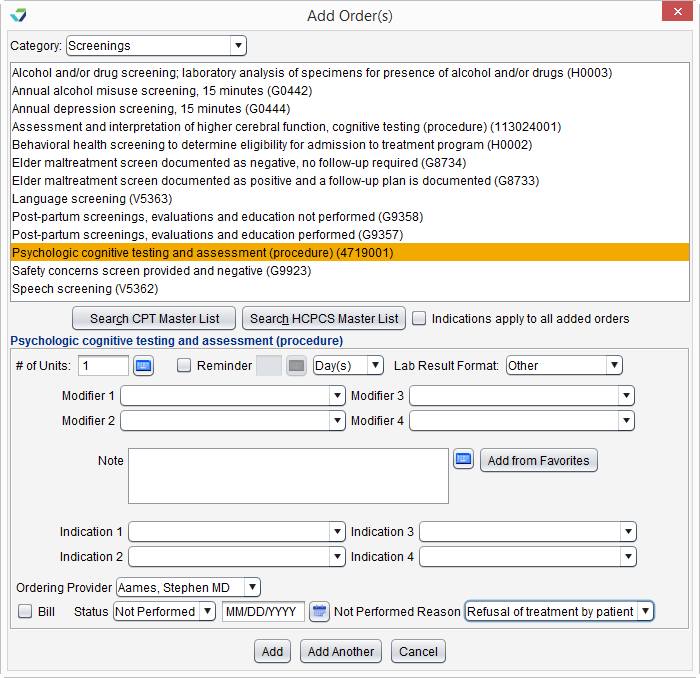
- Go to Encounter > Orders/Procedure > Orders/Referrals
Click Add to add one of the following eligible codes:
SNOMED CT: 113024001, 4719001
- Order Status must be Not Performed
- Not Performed Reason must be Refusal of treatment by patient
- Click Add to save
Note
SNOMED CT codes must be added as a Favorite in Preferences > Form Data > Orders to be accessible from the Orders/Referrals tab
Numerator
A patient will be counted in the numerator if they received a cognitive assessment using a standardized screening on the day of their eligible dementia encounter or in the 12 months before their eligible dementia encounter.
Cognitive Assessment Performed
To document a screening using the Cognitive Assessment flowsheet:
- Go to Encounter > Flowsheets/Labs > Standard or Chart > Flowsheets/Labs > Standard
- Click Add New Flowsheet
- Select the Cognitive Assessment flowsheet and click Add
- Click Add Column
Populate the patient’s score for the AD8, Mini-Cog, MMSE, MoCA, or SLUMS assessment
or
Select the Other cognitive assessment performed checkbox
- Click OK to save

Sevocity Best Practice
If Other cognitive assessment performed is selected, the name of the screening tool should be documented in the encounter in which it was performed
eCQI Reference
Return to 2023 eCQMs