
| Measure: The percentage of adolescent patients 12 to 17 years of age and adult patients 18 years of age or older with major depression or dysthymia who reached remission 12 months (+/- 60 days) after an index event | ||
| Measure Type | High Priority Measure | Scoring |
| Outcome | Yes | A higher percentage indicates better quality |
| Denominator | Adolescent patients 12 to 17 years of age and adult patients 18 years of age and older with a diagnosis of major depression or dysthymia and an initial PHQ-9 or PHQ-9M score greater than nine during the index event. Patients may be assessed using PHQ-9 or PHQ-9M on the same date or up to 7 days prior to the encounter (index event) |
| Numerator | Adolescent patients 12 to 17 years of age and adult patients 18 years of age and older who achieved remission at twelve months as demonstrated by the most recent twelve month (+/- 60 days) PHQ-9 or PHQ-9M score of less than five |
| Denominator Exceptions | None |
| Denominator Exclusions |
|
Denominator
Patients who meet the following criteria will be included in the denominator:
Age is ⥠12 years at the time of the initial PHQ-9 assessment
AND
Have a PHQ-9 score > 9 on the day of the eligible encounter or in the 7 days prior to the encounter
AND
- Have at least one eligible encounter with an active diagnosis of major depression or dysthymia in the 14 to 2 months prior to the Measurement Period finalized by the EC
Encounter Codes Eligible for Denominator
CPT: 90791, 90972, 90832, 90834, 90837, 90839, 96156, 96158, 96159, 99202, 99203, 99204, 99205, 99211, 99212, 99213, 99214, 99215, 99384, 99385, 99386, 99387, 99394, 99395, 99396, 99397, 99421, 99422, 99423, 99441, 99442, 99443
HCPCS: G0402, G0438, G0439
Diagnosis
Diagnoses are documented in the Assessment tab of an encounter. The eligible diagnosis codes for major depression and dysthymia are:
Major Depression
ICD-10: F32.0, F32.1, F32.2, F32.3, F32.4, F32.5, F32.9 , F33.0, F33.1, F33.2 , F33.3, F33.40, F33.41 , F33.42, F33.9
Dysthymia
ICD-10: F34.1
PHQ-9 Assessment
To document a PHQ-9 assessment:
- Go to Encounter > Flowsheets/Labs > Standard or Chart > Flowsheets/Labs > Standard
- Click Add New Flowsheet
- Select the PHQ-9 flowsheet and click Add
- Click Add Column
- Select a Value for all questions in the PHQ-9
- Click OK to save
Denominator Exclusions
A patient will be excluded from the measure if they meet any of the following conditions:
Died any time prior to the end of the measure assessment period
Received hospice or palliative care services between the start of the denominator period and the end of the measurement assessment period
Had a diagnosis of bipolar disorder, personality disorder emotionally labile, schizophrenia or psychotic disorder, or pervasive developmental disorder any time prior to the end of the measure assessment period
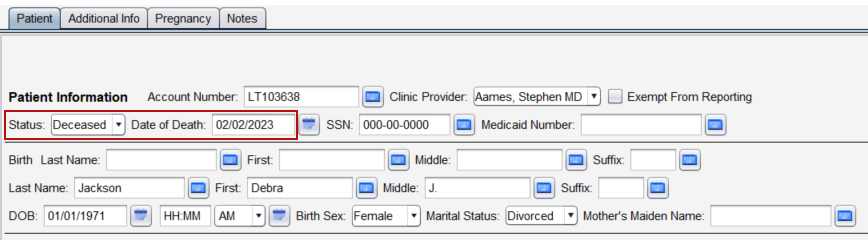
Patient Death
To document a patient death:
Go to Chart > Demographics > Patient Info
Click Update
Update patient Status to Deceased
Populate the Date of Death field
Click Save
Hospice Care Services
To document hospice care ambulatory services, go to Encounter > Orders/Procedure > Orders/Referrals and click Add to add one of the eligible codes listed below:
CPT: 99377, 99378
HCPCS: G0182
Order Status must be marked as Pending or Complete.
To document hospice care encounter services, go to Encounter > Orders/Procedure > Orders/Referrals and click Add to add one of the eligible codes listed below:
HCPCS: G9473, G9474, G9475, G9476, G9477, G9478, G9479, Q5003, Q5004, Q5005, Q5006, Q5007, Q5008, Q5010, S9126, T2042, T2043, T2044, T2045, T2046
Order Status must be marked as Complete.
Palliative Care
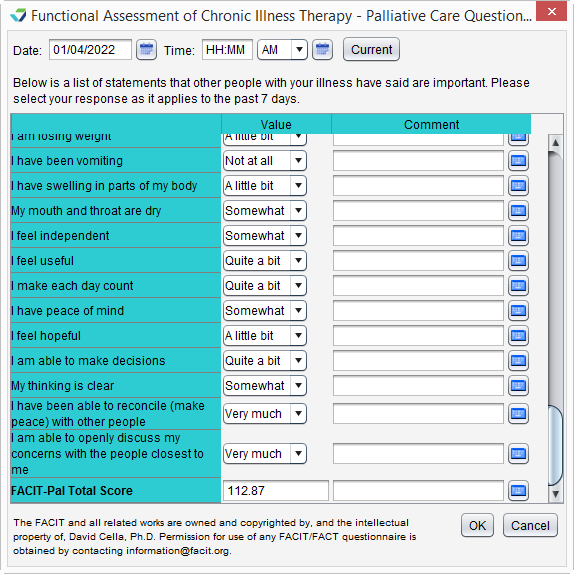
Palliative care services can be documented using the FACIT-Pal Questionnaire flowsheet, as an order, or as a diagnosis.
FACIT-Pal Questionnaire Flowsheet
Go to Encounter > Flowsheets/Labs > Standard or Chart > Flowsheets/Labs > Standard
Click Add New Flowsheet
Select the FACIT-Pal Questionnaire flowsheet and click Add
Click Add Column
Populate the patient’s responses to the questions as appropriate
Click OK to save
Palliative Care Services Order
Go to Encounter > Orders/Procedure > Orders/Referrals and click Add to add one of the eligible codes listed below:
HCPCS: G9054
Order Status must be marked as Complete.
Palliative Care Diagnosis
Diagnoses are documented in the Assessment tab of an encounter. The eligible diagnosis code for palliative care is:
ICD-10: Z51.5
Diagnosis
Diagnoses are documented in the Assessment tab of an encounter. A comprehensive list of eligible bipolar disorder, personality disorder emotionally labile, schizophrenia or psychotic disorder, and pervasive developmental disorder codes can be located here.
Numerator
A patient will be counted in the numerator if they achieved depression remission at twelve months as demonstrated by the most recent twelve month (+/- 60 days) PHQ-9 score less than five.
PHQ-9 Assessment
To document a PHQ-9 assessment:
- Go to Encounter > Flowsheets/Labs > Standard or Chart > Flowsheets/Labs > Standard
- Click Add New Flowsheet
- Select the PHQ-9 flowsheet and click Add
- Click Add Column
- Select a Value for all questions in the PHQ-9
- Click OK to save
eCQI Reference
Return to 2025 eCQMs