CMS 347v7: Statin Therapy for the Prevention and Treatment of Cardiovascular Disease
Measure: Percentage of the following patients - all considered at high risk of cardiovascular events - who were prescribed or were on statin therapy during the measurement period:
| ||
| Measure Type | High Priority Measure | Scoring |
| Process | No | A higher percentage indicates better quality |
| Denominator | Denominator 1: All patients who were previously diagnosed with or currently have a diagnosis of clinical ASCVD, including an ASCVD procedure Denominator 2: Patients aged 20 to 75 years at the beginning of the measurement period who have ever had a laboratory result of LDL-C ≥ 190 mg/dL or were previously diagnosed with or currently have an active diagnosis of familial hypercholesterolemia Denominator 3: Patients aged 40-75 years at the beginning of the measurement period with Type 1 or Type 2 diabetes Denominator 4: Patients aged 40-75 at the beginning of the measurement period with a 10-year ASCVD risk score (i.e., 2013 ACC/AHA ASCVD Risk Estimator or the ACC Risk Estimator Plus) of ≥ 20 percent during the measurement period. |
| Numerator | Patients who are actively using or who receive an order (prescription) for statin therapy at any time during the measurement period |
| Denominator Exceptions |
|
| Denominator Exclusions |
|
 Setup Note
This eCQM requires a lab interface to be met. Customers interested in a lab interface should contact Sevocity Support to begin the process of a new interface setup. Interface setup requirements and fees vary per request.
DenominatorDenominator 1Patients who meet the following criteria will be included in the denominator:
Have a diagnosis of clinical ASCVD during the Measurement Period or who have ever had an ASCVD procedure
AND
- Have at least one eligible encounter during the Measurement Period finalized by the EC
Encounter Codes Eligible for Denominator 1CPT: 99201, 99202, 99203, 99204, 99205, 99212, 99213, 99214, 99215, 99241, 99242, 99243, 99244, 99245, 99395, 99396, 99397, 99429, 99401, 99402, 99403, 99404, 99385, 99386, 99387
HCPCS: G0438, G0439
DiagnosisThe patient must have a diagnosis of clinical ASCVD during Measurement Period. Diagnoses are documented in the Assessment tab of an encounter. A comprehensive list of eligible diagnosis codes for clinical ASCVD can be located here.
ASCVD ProcedureTo document an ASCVD procedure as an order, go to Encounter > Orders/Procedure > Orders/Referrals and click Add to add one of the eligible codes listed below:
CPT: 33510, 33511, 33512, 33513, 33514, 33516, 33517, 33518, 33519, 33521, 33522, 33523, 33533, 33534, 33535, 33536, 92920, 92924, 92928, 92933, 92937, 92941, 92943
HCPCS: S2205, S2206, S2207, S2208, S2209
Order Status must be marked as Complete.
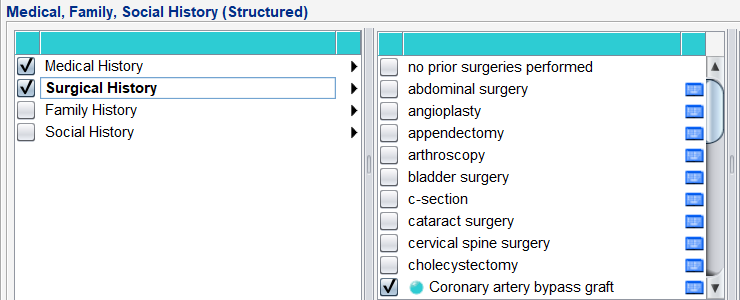
To document an ASCVD procedure from the patient history, Go to Encounter > Past History > Structured > Surgical History and select the hardcoded Coronary artery bypass graft node
Denominator 2Patients who meet the following criteria will be included in the denominator:
Age is 20 to 75 years at the beginning of the Measurement Period
AND
Had an LDL cholesterol (LDL-C) lab result ≥ 190 mg/dL or was previously diagnosed with or currently have an active diagnosis of familial hypercholesterolemia
AND
Do not have a diagnosis of ASCVD or any prior ASCVD procedure
AND
- Have at least one eligible encounter during the Measurement Period finalized by the EC
Encounter Codes Eligible for Denominator 2CPT: 99201, 99202, 99203, 99204, 99205, 99212, 99213, 99214, 99215, 99241, 99242, 99243, 99244, 99245, 99395, 99396, 99397, 99429, 99401, 99402, 99403, 99404, 99385, 99386, 99387
HCPCS: G0438, G0439
LDL-C ResultTo document the LDL-C lab result, it must be stored as an e-Lab in the patient chart.
- From the Clinic Inbox, select the lab result to be stored and click View
- If the lab result is systematically matched to a patient, the Patient section will be populated in the lab result display
- If the lab result is not matched or the matched patient needs to be changed, the user will need to search for the patient
- Optional: click Select to search for and select a patient
- Select the I have verified the following lab results belong to the above patient checkbox
- Click Sign/Route
- Select the Sign checkbox and click OK
Stored e-Lab results can be viewed in the Flowsheets/Labs > Scanned/E-Labs tab of the patient chart.
DiagnosisDiagnoses are documented in the Assessment tab of an encounter. The eligible diagnosis code for familial hypercholesterolemia is:
ICD-10: E78.01
ASCVD Diagnosis and ProcedureSee Denominator 1 for eligible codes.
Denominator 3Patients who meet the following criteria will be included in the denominator:
Age is 40 to 75 years at the beginning of the Measurement Period
Have a diagnosis of diabetes during the Measurement Period
Do not have a diagnosis of ASCVD or any prior ASCVD procedure or an LDL-C lab result ≥ 190 mg/dL or a previous or current diagnosis of familial hypercholesterolemia
Have at least one eligible encounter during the Measurement Period finalized by the EC
AND
AND
AND
Encounter Codes Eligible for Denominator 3CPT: 99201, 99202, 99203, 99204, 99205, 99212, 99213, 99214, 99215, 99241, 99242, 99243, 99244, 99245, 99395, 99396, 99397, 99429, 99401, 99402, 99403, 99404, 99385, 99386, 99387
HCPCS: G0438, G0439
DiagnosisDiagnoses are documented in the Assessment tab of an encounter. A comprehensive list of eligible diagnosis codes for diabetes can be located here.
ASCVD Diagnosis and ProcedureSee Denominator 1 for eligible codes.
LDL-C Result and Familial Hypercholesterolemia DiagnosisSee Denominator 2 for eligible criteria.
Denominator 4Age is 40 to 75 years at the beginning of the Measurement Period
Have a 10-year ASCVD risk score of ≥ 20 percent during the Measurement Period
AND
Do not have a diagnosis of diabetes during the Measurement Period
Do not have a diagnosis of ASCVD during the Measurement Period or any prior ASCVD procedure or an LDL-C lab result ≥ 190 mg/dL or a previous or current diagnosis of familial hypercholesterolemia
Have at least one eligible encounter during the Measurement Period finalized by the EC
AND
AND
AND
Encounter Codes Eligible for Denominator 4CPT: 99201, 99202, 99203, 99204, 99205, 99212, 99213, 99214, 99215, 99241, 99242, 99243, 99244, 99245, 99395, 99396, 99397, 99429, 99401, 99402, 99403, 99404, 99385, 99386, 99387
HCPCS: G0438, G0439
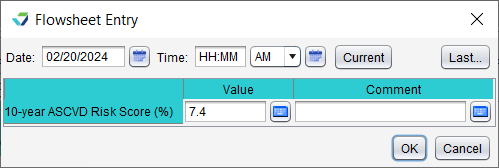
ASCVD Risk ScoreTo document an ASCVD Risk Score for a patient:
Go to Encounter > Flowsheets/Labs > Standard or Chart > Flowsheets/Labs > Standard
Click Add New Flowsheet
Select the ASCVD Risk Score flowsheet and click Add
Click Add Column
Enter the score in the Value field
Click OK to save
DiagnosisDiagnoses are documented in the Assessment tab of an encounter. The comprehensive list of diagnosis codes for ASCVD and diabetes can be located here.
ASCVD ProcedureSee Denominator 1 for eligible codes.
LDL-C Result and Familial Hypercholesterolemia DiagnosisSee Denominator 2 for eligible criteria.
Denominator ExceptionsA patient will be counted as an exception for this measure if they meet any of the following conditions:
Is in hospice care for any part of the Measurement Period
Is receiving palliative care for any part of the Measurement Period
Has a diagnosis of hepatitis, liver disease, statin associated muscle symptoms, or ESRD
Has an allergy to statin medication
Has a medical reason for not being prescribed statin therapy
Hospice Care ServicesTo document hospice care ambulatory services, go to Encounter > Orders/Procedure > Orders/Referrals and click Add to add one of the eligible codes listed below:
CPT: 99377, 99378
HCPCS: G0182
Order Status must be marked as Pending or Complete.
To document hospice care encounter services, go to Encounter > Orders/Procedure > Orders/Referrals and click Add to add one of the eligible codes listed below:
HCPCS: G9996, G9473, G9474, G9475, G9476, G9477, G9478, G9479, Q5003, Q5004, Q5005, Q5006, Q5007, Q5008, Q5010, S9126, T2042, T2043, T2044, T2045, T2046
Order Status must be marked as Complete.
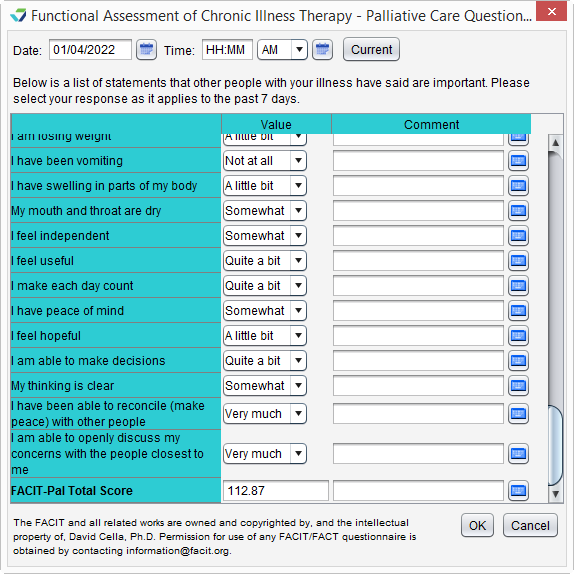
Palliative CarePalliative care services can be documented using the FACIT-Pal Questionnaire flowsheet, as an order, or as a diagnosis.
FACIT-Pal Questionnaire FlowsheetGo to Encounter > Flowsheets/Labs > Standard or Chart > Flowsheets/Labs > Standard
Click Add New Flowsheet
Select the FACIT-Pal Questionnaire flowsheet and click Add
Click Add Column
Populate the patient's responses to the questions as appropriate
Click OK to save
Palliative Care Services OrderGo to Encounter > Orders/Procedure > Orders/Referrals and click Add to add one of the eligible codes listed below:
HCPCS: G9054
Order Status must be marked as Complete.
Palliative Care DiagnosisDiagnoses are documented in the Assessment tab of an encounter. The eligible diagnosis code for palliative care is:
ICD-10: Z51.5
DiagnosisDiagnoses are documented in the Assessment tab of an encounter. The eligible diagnosis codes for these exceptions are:
Hepatitis A
ICD-10: B15.0, B15.9
Hepatitis B
ICD-10: B16.0, B16.1, B16.2, B16.9, B18.0, B18.1, B19.10, B19.11
Liver Disease
ICD-10: B17.0, B17.10, B17.11, B17.2, B17.8, B17.9, B18.2, B18.8, B18.9, B19.0, B19.20, B19.21, B19.9, K70.0, K70.10, K70.11, K70.2, K70.30, K70.31, K70.40, K70.41, K70.9, K71.0, K71.10, K71.11, K71.2, K71.3, K71.4, K71.50, K71.51, K71.6, K71.7, K71.8, K71.9, K72.00, K72.01, K72.10, K72.11, K72.90, K72.91, K73.0, K73.1, K73.2, K73.8, K73.9, K74.00, K74.01, K74.02, K74.1, K74.2, K74.3, K74.4, K74.5, K74.60, K74.69, K75.4, O98.411, O98.412, O98.413, O98.419B17.0, B17.10, B17.11, B17.2, B17.8, B17.9, B18.2, B18.8, B18.9, B19.0, B19.20, B19.21, B19.9, K70.0, K70.10, K70.11, K70.2, K70.30, K70.31, K70.40, K70.41, K70.9, K71.0, K71.10, K71.11, K71.2, K71.3, K71.4, K71.50, K71.51, K71.6, K71.7, K71.8, K71.9, K72.00, K72.01, K72.10, K72.11, K72.90, K72.91, K73.0, K73.1, K73.2, K73.8, K73.9, K74.00, K74.01, K74.02, K74.1, K74.2, K74.3, K74.4, K74.5, K74.60, K74.69, K75.4, O98.411, O98.412, O98.413, O98.419
Statin Associated Muscle Symptoms
ICD-9: 359.9, 729.1
ICD-10: G72.0, G72.9, M60.9, M79.10
End Stage Renal Disease
ICD-10: N18.6
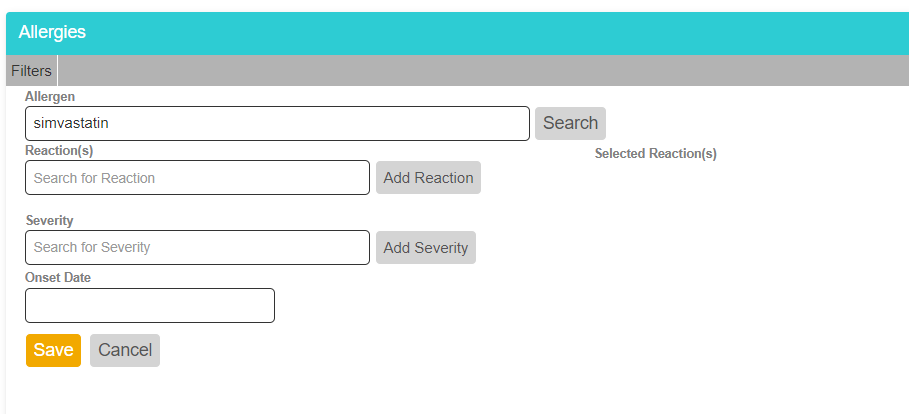
Allergy to Statin MedicationTo document a patient allergy to statin medication:
Go to Encounter > Allergies/Meds Hx > Manage Allergies/Med Hx or Chart > Medications/Assessments > Modify
From the Allergies section, click the Add Allergen icon (
 )
)From the Allergen field, search for and add one of the following items :
rosuvastatin
simvastatin
fluvastatin
pravastatin
lovastatin
atorvastatin
pitavastatin
Statins-Hmg-Coa Reductase Inhibitors
Optional: populate additional information about the allergy
Click Save
Medical Reason To document a medical reason the patient was not prescribed statin therapy:
Go to Encounter > Orders/Procedure > Orders/Referrals
Click Add to add one of the following eligible codes:
Order Status must be Not Performed
Not Performed Reason must be Procedure contraindication
Click Add to save
HCPCS: G8815, G8817
Denominator ExclusionsA patient will be excluded from this measure if they meet any of the following conditions:
- Are breastfeeding at any time during the Measurement Period
- Have a diagnosis of rhabdomyolysis at any time during the Measurement Period
Diagnoses are documented in the Assessment tab of an encounter. The eligible diagnosis codes for these exclusions are:
Breastfeeding
ICD-10: O91.03, O91.13, O91.23, O92.03, O92.13, O92.5, O92.70, O92.79, Z39.1
Rhabdomyolysis
ICD-10: M62.82, T79.6XXA, T79.6XXD, T79.6XXS
NumeratorA patient will be counted in the numerator if they are actively using or receive a prescription for statin therapy at any time during the Measurement Period.
MedicationTo prescribe a medication for statin therapy, go to Encounter > Medications > Manage/Prescribe Meds > New Prescription or Chart > Medications/Assessments > Modify. A comprehensive list of eligible medications can be located here.
Return to 2024 eCQMs
Didn't find the answer you were looking for?
Contact Sevocity Support 24/7 at 877‑777‑2298 or support@sevocity.com